



What is it?
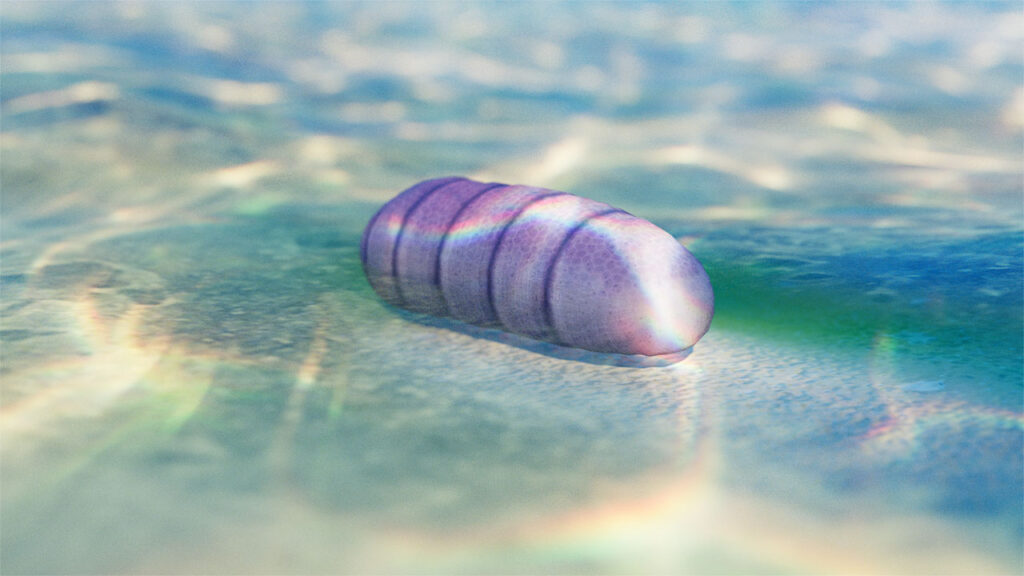
Ikaria is a simple organism, the shape of a grain of rice but even smaller.
It had a symmetrical body shape with a front, a back, and a through-gut, similar to the body plan of most modern animals. It is the earliest known ‘bilaterian’, making it our closest relative out of all of the Ediacara Biota. It is also the first known animal to independently move on the planet.
It is thought that the Ikaria moved around the seafloor looking for oxygen rich environments, which implies that it had some sensory ability, remarkable for an animal that old. It is surprisingly complex compared to other animals alive at the same time.
Interestingly, long before Ikaria fossils were discovered, scientists predicted that an animal like Ikaria must have existed and what it would look like. This is a case of palaeontological prediction being spot on.
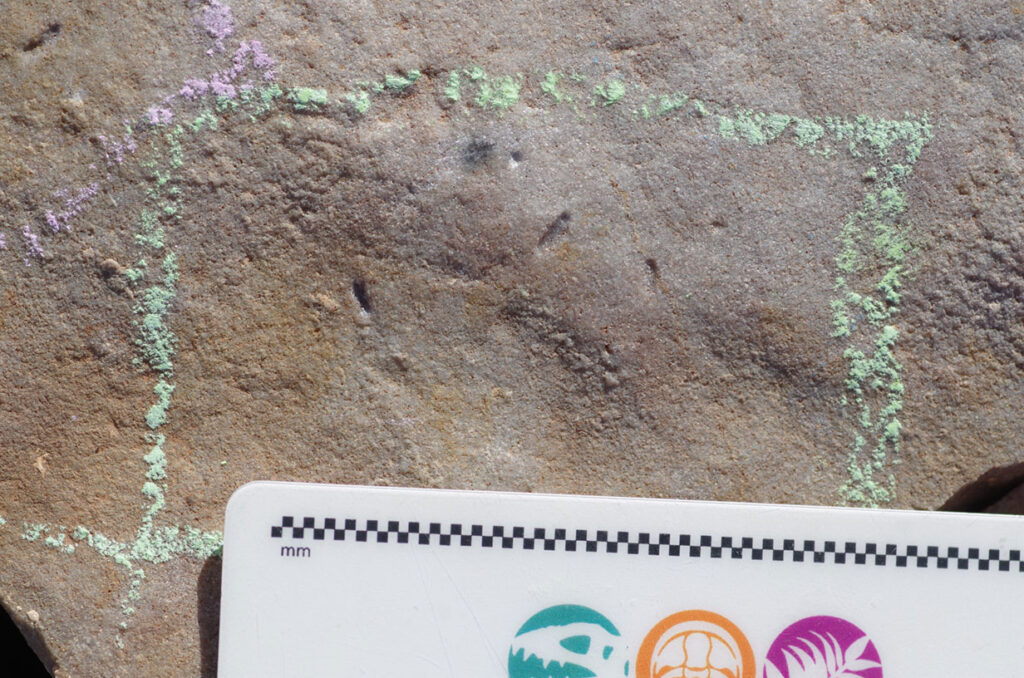
This is a fossil of an Ikaria warioota specimen
How do we know?
We know how Ikaria moved because of trace fossils called ‘Helminthoidichnites’. These fossils were left behind when Ikaria burrowed under thin layers of sand. It likely moved through a process called peristalsis, similar to an earth worm.
There is also some evidence that Ikaria were scavengers, meaning that they ate the bodies of other dead animals. We know this as trace fossils from Ikaria have been found in the body fossils of other decaying animals. If true, this would be the earliest evidence of such behaviour.
Ikaria
Warioota
Ikara is the Adnyamathanha name for Wilpena Pound, and means “meeting place” in the Adnyamathanha language. Ikara is the major land-mark in view from Nilpena, and the fossil has been named to acknowledge the original custodians of the land. The species are named for Warioota Creek, which runs from the Flinders Ranges to Nilpena Station.