



What is it?
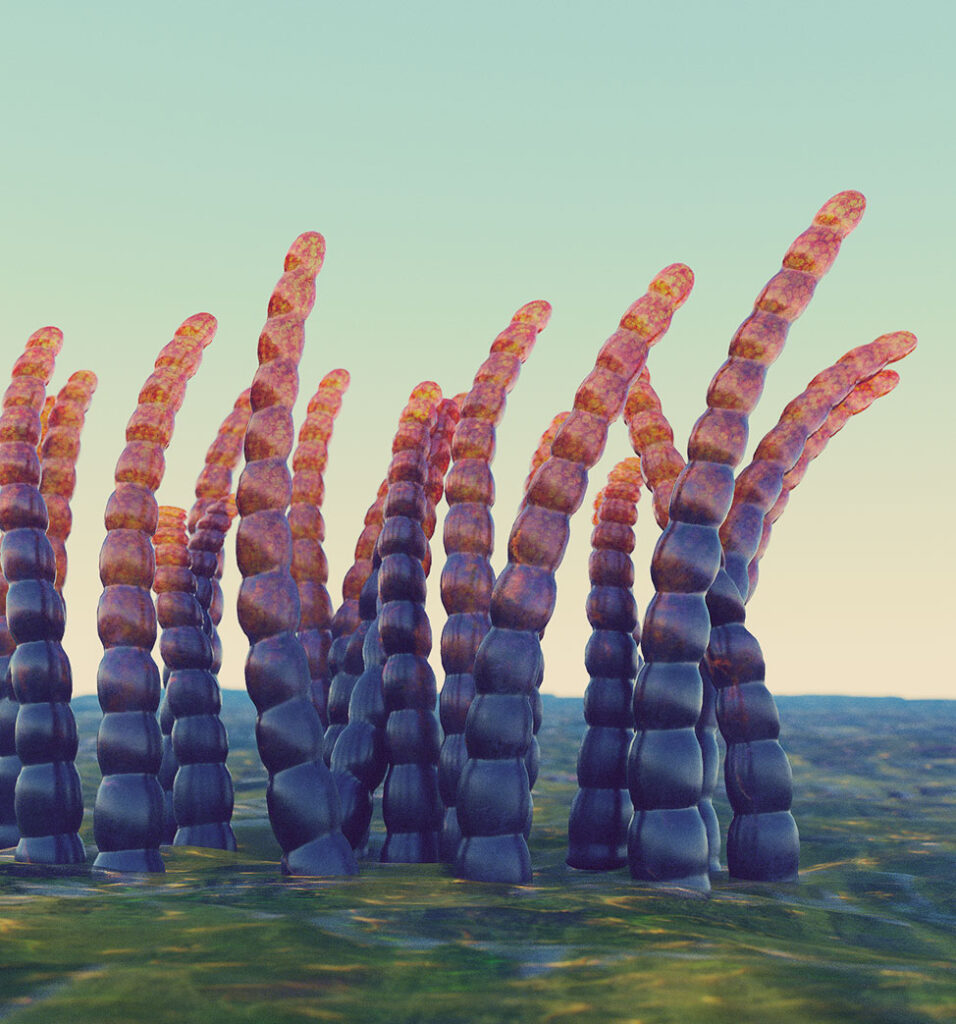
Funisia were long, hollow organisms made up of stacked, barrel-shaped modules that stood upright in the water column and were attached to the seafloor with a holdfast.
They were most commonly found in clusters of very closely spaced individuals. Sometimes there are as few as 10 Funisia in these clusters but other times they can cover several square meters with an estimated number of over 1,000 individual Funisia.
Funisia are actually the most commonly occurring organism at Nilpena Ediacara National Park, with thousands of specimens identified to date.
If you were snorkelling in the Ediacaran ocean, Funisia clusters would look a lot like the seagrass meadows we see in oceans today. However, there are two important pieces of information that tell us these were animals and not plants. The first is that they were able to live in the water at depths that would have made photosynthesis impossible. The second is their body structure. They’re thick and chunky, more like the body of a soft coral than the thin fronds of a seaweed.
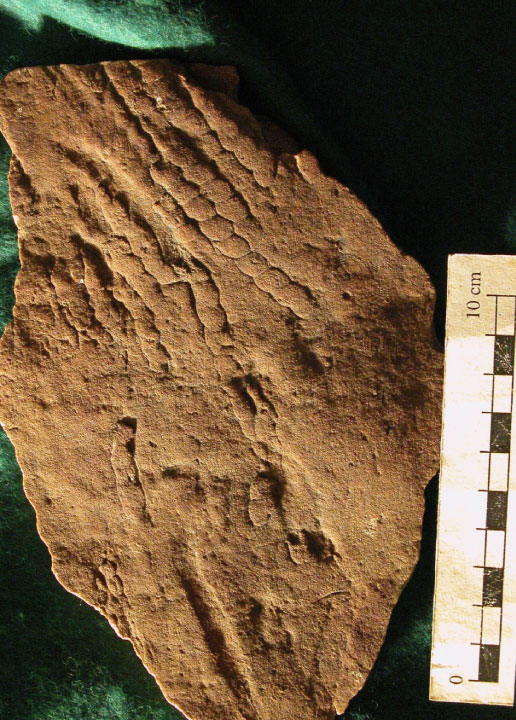
This is fossil of a Funisia dorothea specimen
How do we know?
The palaeontologists who discovered Funisia carefully examined the fossils and noticed that the clusters of individual Funisia were all the same size. This was notable because it implies that they are the exact same age. From this, palaeontologists were able to deduce that they were a product of sexual reproduction. This would have occurred via a process called ‘spawning’, where a cloud of sperm and eggs were released into the water by multiple different parent Funisia. They then joined together to form a ‘spat’ of embryos, which would have landed together on the seafloor and begun to grow. This is the first evidence of sexual reproduction on the planet.
Interestingly, Funisa also reproduced via a process called budding, which is when the organism grows a branch off of its main body, which then separates to create a new individual. This is very similar to the way modern corals and jellyfish reproduce, suggesting that Funisia was an early relative of these animals.